SYNDROME MAY-THURNER
Cockett syndrome, also known as May-Thurner syndrome, manifests as the compression of the left common iliac vein by the right common iliac artery against the lumbar vertebrae. This relatively rare syndrome affects mainly young women, although it can also be diagnosed in men.
WHAT IS THE TREATMENT FOR MAY-THURNER SYNDROME?
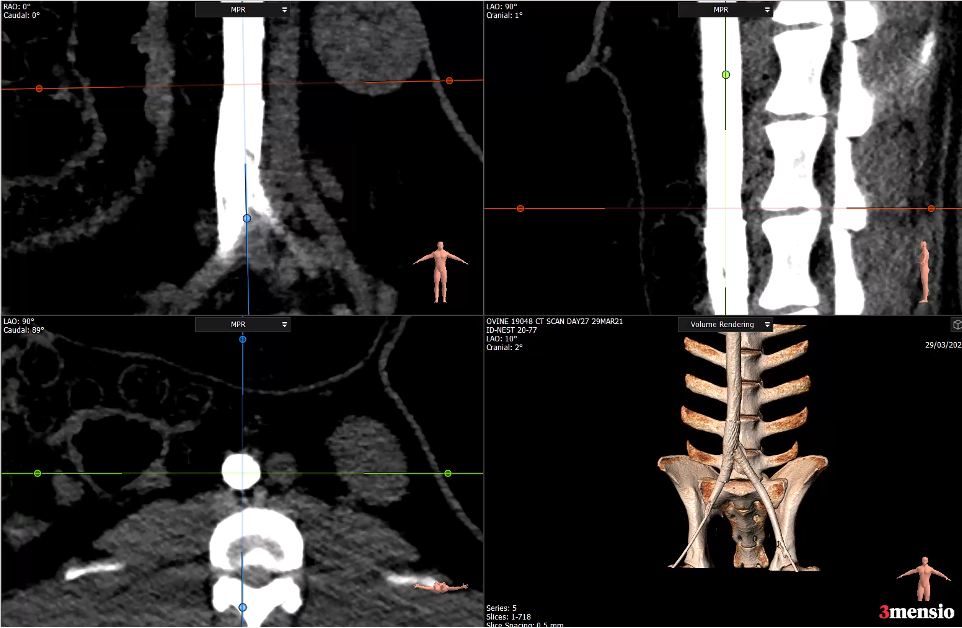
A Doppler ultrasound, a CT scan, a MRI, an endovascular ultrasound and/or IVUS allow visualization of the compression, or even occlusion, of the iliac vein by the artery. The vein is decompressed by stent implantation. Indeed, via a venogram (X-ray of the veins), the vascular surgeon performs vein dilation with a balloon and places a stent to keep the vein open and restore a normal flow.
CLINICAL CONSEQUENCES
The consequences are primarily:
- Risks of phlebitis (DVT) in the left lower limb,
- Intermittent chronic edema of the left lower limb,
- Atypical or recurrent varicose veins in the lower limbs.
- Pelvic congestion syndrome
DESIGN AT THE SERVICE OF PHYSIOLOGY
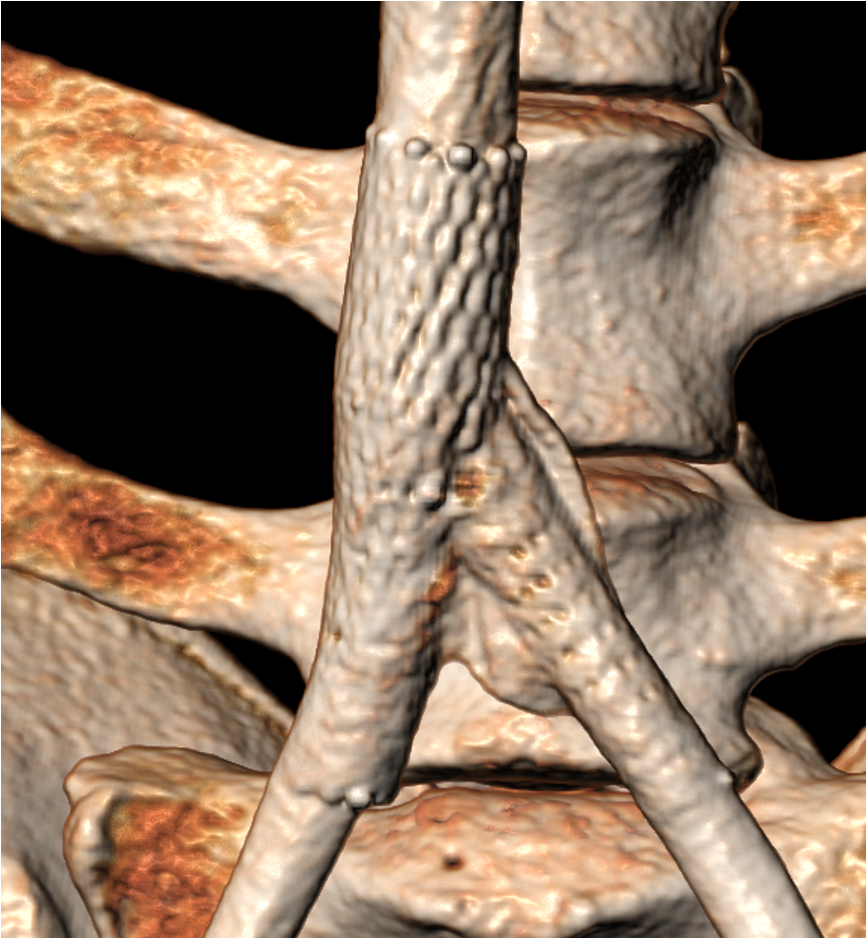
Thanks to its reinforced design, the ID NEST T-Stent technology adapts to the mechanical stresses of the iliac region. It restores continuous and stable venous flow while conforming to the anatomical variations specific to May-Thurner syndrome. Its optimized geometry allows for precise and durable implantation.
A SPECIFICALLY DESIGNED SOLUTION: THE VENOUS T-STENT
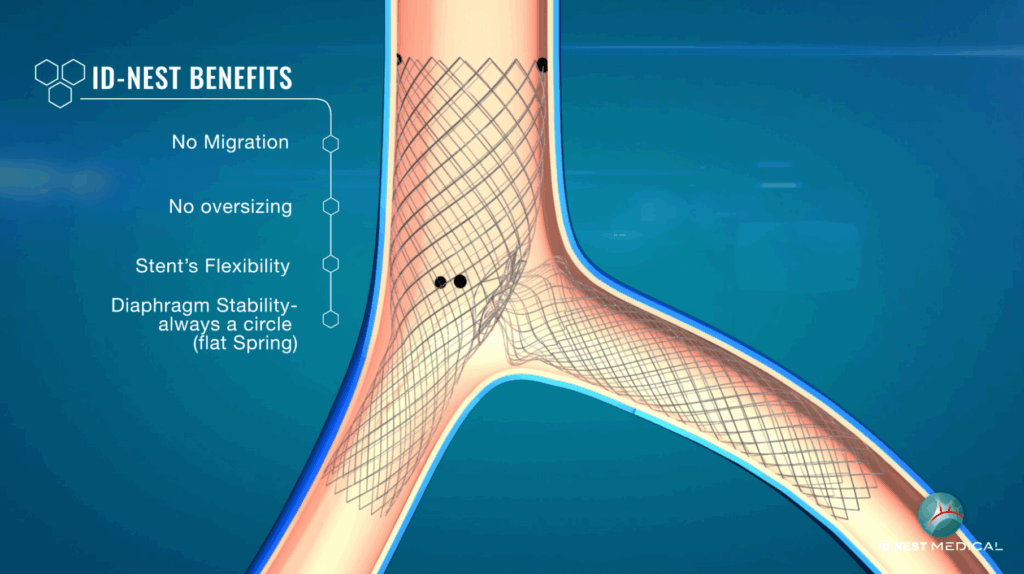
The challenge lies in restoring physiological blood flow without compromising the vein's structure. Developed by ID NEST Medical, the T-Stent venous stent provides a targeted solution to these requirements. Designed to adapt to flexible and constantly evolving venous anatomies, it stands out for the following advantages :

ADAPTIVE STRUCTURAL DESIGN
The Venous T-Stent relies on an assembly of independent stents, designed to conform to the morphological variations of the vein. This modular architecture ensures consistent wall apposition, even in the presence of significant compression, while reducing the risk of mechanical deformation.

CLINICAL MANAGEMENT
The various modules are assembled using a flexible connection system, capable of accommodating the abdomen's physiological movements. This flexibility reduces stress applied to the vein and maintains optimal stability against pressure fluctuations characteristic of May-Thurner syndrome.

SECURE AND DURABLE FIXATION
The T-Stent design guarantees reliable anchoring within an anatomical region subject to high mobility. This enhanced retention eliminates the risk of migration, a critical factor in the treatment of May-Thurner syndrome.
OPERATING PRINCIPLE
T-Stent technology uses a robust self-expanding design allowing for consistent apposition on the venous wall. Its structure ensures uniform and stable expansion, essential for counteracting the compression effect exerted by the iliac artery. It thus restores continuous blood flow and effectively reduces venous stasis.
FAQ
T-STENT SOLUTION
ID NEST Medical is developing a modular technology designed to address complex venous compressions and confluences. The T-Stent offers stability, precision, and adaptability in the most difficult anatomical zones, contributing to sustainable management.