
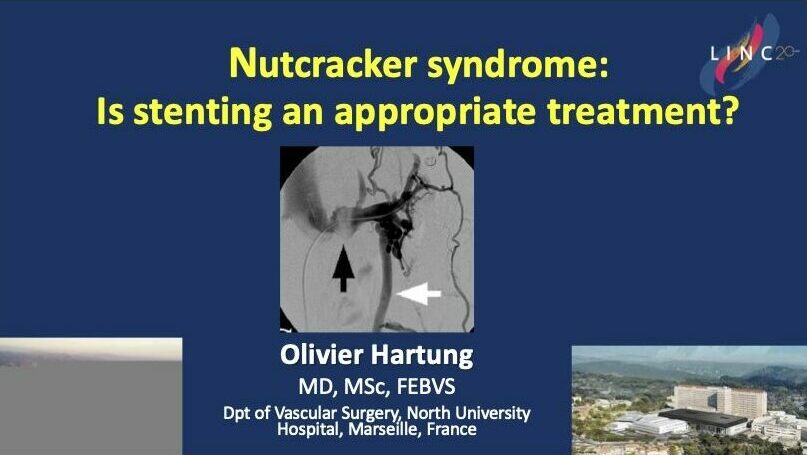
The beginning of 2025 started strong for IDNEST Medical. From January 28 to 30, we were present in Leipzig (Germany) for the LINC (Leipzig Interventional Course), one of the world’s most important congresses dedicated to interventional vascular medicine.
On this occasion, Dr. Olivier Hartung took the floor to ask a central question in the treatment of venous pathologies: Is stenting an appropriate treatment for Nutcracker Syndrome?
The Finding: The Limitations of Current Stents
Endovascular treatment of Nutcracker Syndrome currently faces a major difficulty. As demonstrated by Dr. Hartung during his presentation, the use of non-dedicated stents (designed for other uses) presents real risks.
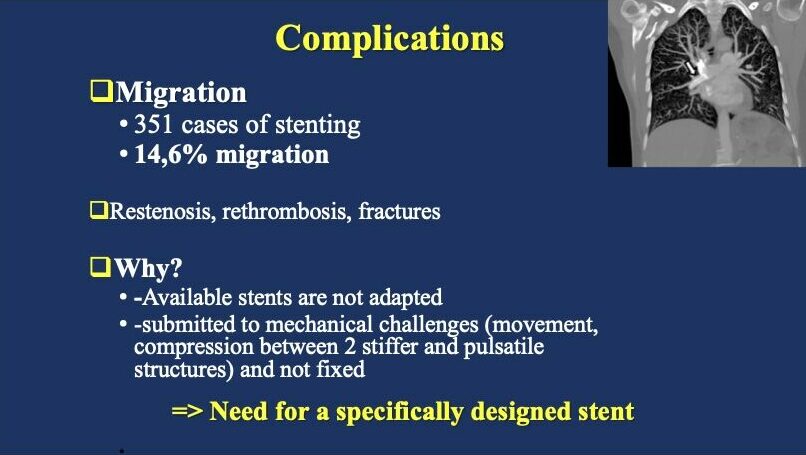
The data presented speaks for itself (see slide above): in a study of 351 stenting cases, a migration rate of 14.6% is observed.
Why? Because current stents are not adapted to the specific mechanical constraints of this anatomical zone (respiratory movements, compression between two rigid and pulsatile structures). The absence of adequate fixation can lead to the displacement of the stent towards the heart, creating serious complications.
The Solution: The T-Stent, a Dedicated Device
Faced with this observation (“Need for a specifically designed stent”), IDNEST Medical provides a concrete technological response. The future of treatment lies in a device designed specifically for this pathology.
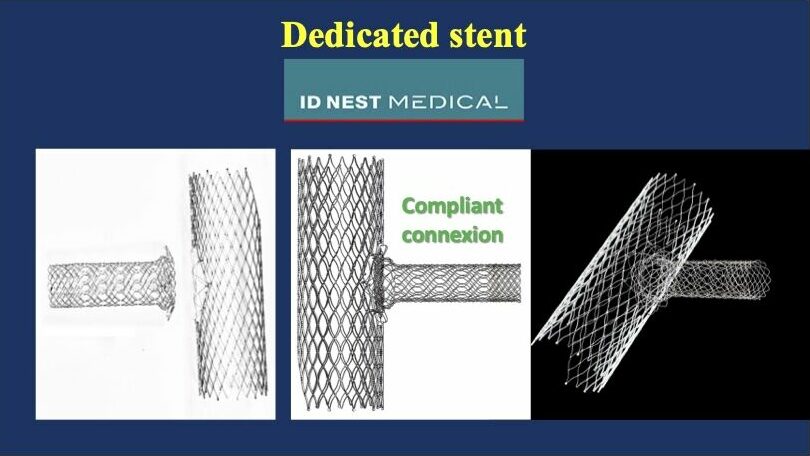
Our solution, the T-Stent, is developed in close collaboration with endovascular surgeons and our partners, including Prof. Nabil Chakfe. As illustrated above, this device is distinguished by:
- A unique architecture (“Compliant connexion”).
- A capacity to adapt to the patient’s physiology without migrating.
This presentation at LINC 2025 confirms that the medical community is waiting for a dedicated solution. IDNEST Medical is proud to carry this innovation which aims to permanently secure the treatment of Nutcracker Syndrome.